

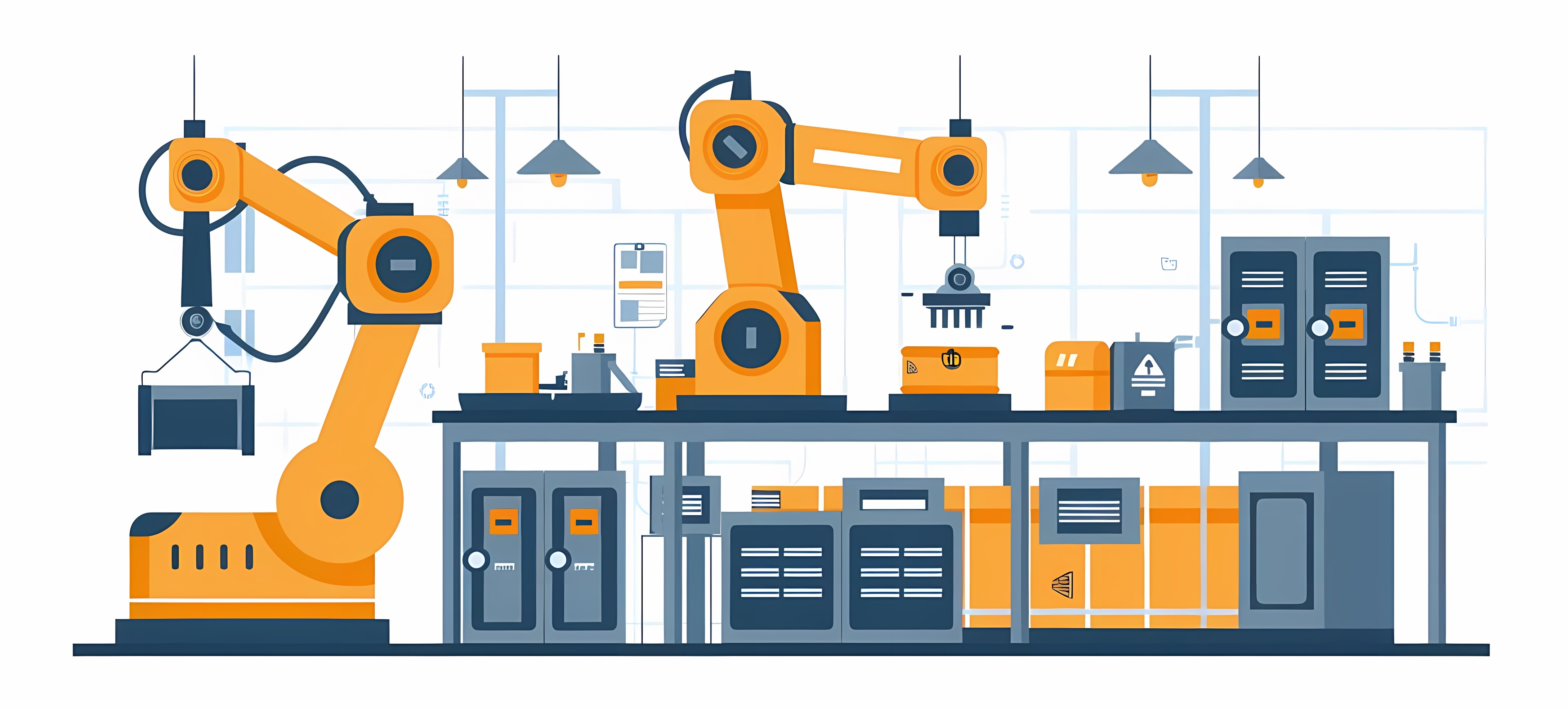
In this article, we will explain what an industrial robot is according to its definition and delve into some technical vocabulary related to industrial robots.
ISO Definition
Let’s start with the definition from the International Organization for Standardization (ISO):
“An automatically controlled, reprogrammable, multipurpose manipulator, programmable in three or more axes, which can be either fixed in place or fixed to a mobile platform for use in automation applications in an industrial environment.” — Industrial robot as defined by ISO 8373:2021
But what do these attributes mean?
Understanding the Attributes
Manipulator
First of all, an industrial robot is known as a manipulator because, unlike mobile or humanoid robots, it is a mechanism used in automation processes and often operates in a skillful way. Most industrial robots are in fact designed to resemble a human arm.
Automatically Controlled
A robotic system typically consists of a manipulator and a controller unit. The controller acts as the brain of the robot, where automation routines are created, stored, and executed. The controller enables the robot to behave purposefully and automatically. The unit can be standalone or integrated with the robot manipulator.
A standard user interface (UI) for a robot controller is called a Teach Pendant (TP) which allows user interaction with the robot. The Teach Pendant is somewhat user-friendly and akin to an old-school TV remote. However, its ease of use is limited compared to modern smart devices or PC software.

Reprogrammable
A program is a set of instructions for robots to perform automation tasks. Robots can be programmed using Teach Pendant or specialised PC software. The process of creating and editing a program is called programming, which often involves trials and test runs. With offline programming software, this can be done on a PC before deploying validated programs onto a controller. Reprogrammable means we can produce and reproduce programs for different applications using the same robot.
Multipurpose
Robots can be used for various automation applications, such as pick and place, machining, welding, and more. Each process may require a specially designed tool attached to the end of the robot arm, known as an End-Effector or EOAT (End of Arm Tooling). This tool does not come with a standard robot and needs to be sourced separately.
Three or More Axes
An industrial robot has multiple connected links, and each moving link allows freedom of movement in one direction, either in a sliding or revolving motion. The number of links determines the degrees of freedom a robot has, and each link can also be called a robot joint or axis. In simple terms:
- An Axis = a Joint = a Link = a Degree of Freedom/Movement
The types of joints or axes are often referred as prismatic (sliding/linear) and revolute (revolving/rotary) in robotics. The most common type of industrial robots is articulated, resembling a human arm with shoulder, elbow, and wrist joints, typically having six axes with six moving joints.

Summary
An industrial robot is a versatile mechanism used in various automation processes. Different end-effector tools are required for different applications. Robots can be programmed to perform automation tasks, and we can reuse a robot for different tasks by giving it new programs to run.
You must be logged in to post a comment.