

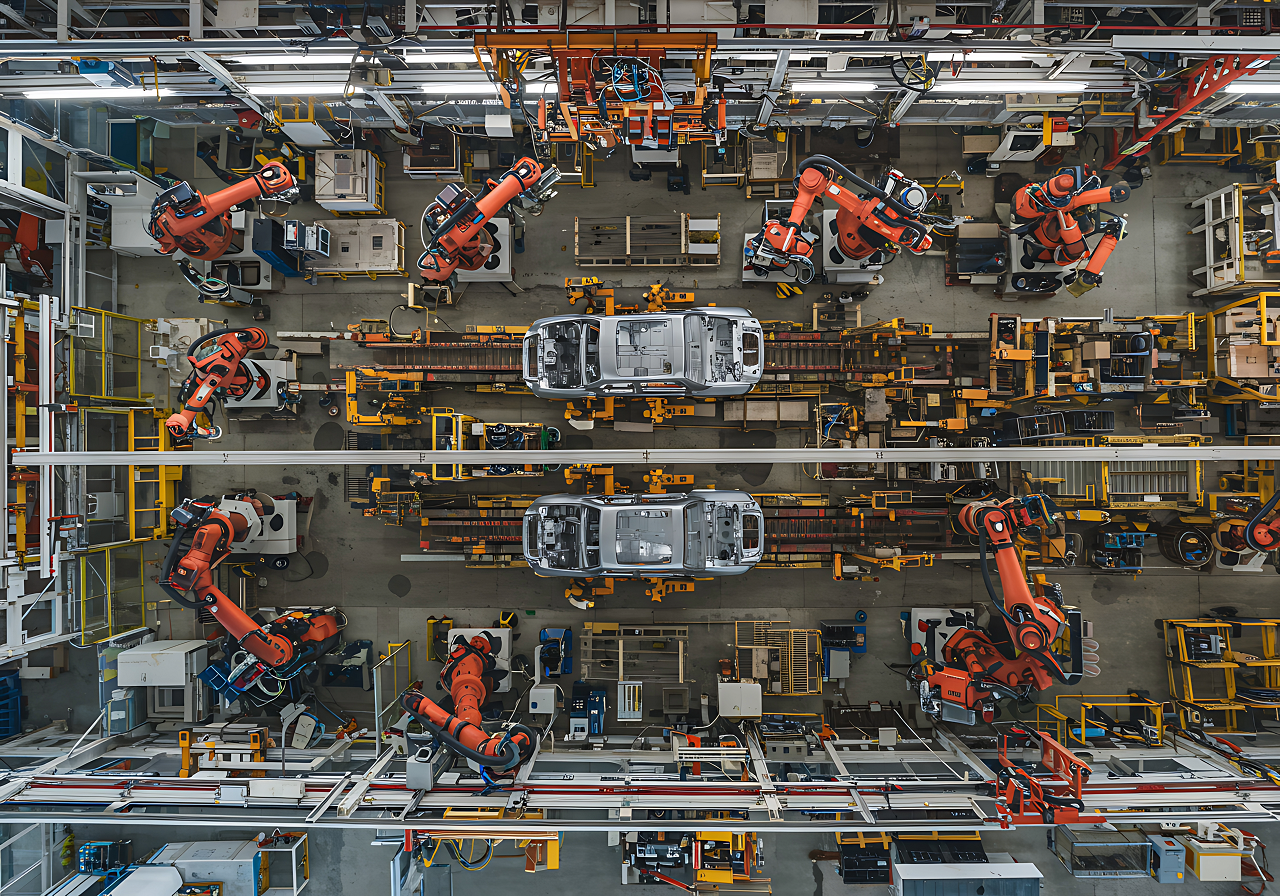
If you visited Automate or Automatica 2025, one trend was impossible to ignore: Chinese robot manufacturers have arrived in force. Their massive booths, wide range of product lines, and bold marketing strategies demonstrated their ambition to become dominant suppliers, rather than consumers of automation technology.
Over the past 10 to 15 years, the ‘Made in China’ label has reshaped global industries. Driven by the high demand from electronics and automotive manufacturers, as well as the government’s MIC2025 plan, China’s adoption of industrial robots has grown rapidly. This prowth has only accelerated further with the recent expansion of the electric vehicle (EV) and photovoltaic (PV) sectors.
But the question is: Who are the Chinese robot makers, and how far are they planning to go?
A Massive Market and Productive Manufacturer
To understand China’s role in industrial robotics, we need to appreciate its dual identity:
- China is the world’s largest market for industrial robots
- China is also becoming one of the largest producers of these robots
According to Xinhua News, China has remained the world’s largest industrial robot market for 11th consecutive years. In 2024 alone, over 294,000 robots were sold in China, accounting for roughly 50% of global demand.
Just over ten years ago, this market was dominated by foreign brands, especially the so-called Big Four: FANUC (Japan), KUKA (Germany), ABB (Switzerland), and Yaskawa Motoman (Japan). But the reshuffling has become obvious. In 2024, 52% of industrial robots sold in China were made by domestic manufacturers, up from 47% in 2023. FANUC remains the largest single player, with a 11% market share, but Chinese company Estun follows closely at 9.5%.
Leader in Cobots and Light-Duty Robotics
Chinese manufacturers are especially strong in collaborative robots (cobots), where they now supply over 92% of the domestic market. Their success comes from combining cost-efficiency, agile engineering, and the benefits of China’s robust supply chain ecosystem. These advantages allow domestic cobot brands to offer highly competitive pricing to their customers.
The same trend is seen in Delta, SCARA, and six-axis robots under 20kg payloads, where local firms often outperform foreign competitors in both unit sales and turnaround times. Inovance, one of the leading Chinese manufacturers, supplied 27.3% of all SCARA robots sold in China in 2024.
However, in the heavy-duty six-axis robot category (payloads >20kg), foreign brands still hold over 60% market share, largely due to their technical leadership in areas like automotive and heavyweight manufacturing. Still, with China’s rapid R&D and scale-up capabilities, this lead may not last much longer.
Made-in-China Robots: The Top Four
So, who are the leading Chinese robot manufacturers, and what makes them stand out? According to sales data in 2024, the top four are:
1. ESTUN Automation
Founded in 1993, Estun began as a servo systems manufacturer before expanding into industrial robotics. It is considered the first industrial robot manufacturer in China and an exemplary success in this space. In 2017, Estun acquired Trio Motion Technology, a UK-based company known for advanced motion control systems, followed by the acquisition of Cloos, a German robotic welding specialist, in 2018. Other acquisitions include 20% of Euclid Labs (Italy) and MAI (Germany), manifesting Estun’s ambition to become a world-leading robotics company.
Today, Estun offers a comprehensive range of robots, with payloads from 3kg to 1000kg, and serves industries from automotive to welding and warehousing. With a 9.5% market share in 2024, Estun is now China’s largest domestic industrial robot manufacturer.
2. INOVANCE Technology
This is the fastest growing company in Chinese robotics. Founded in 2003 by a group of former Huawei engineers, Inovance originally focused on frequency converters and servo systems. It wasn’t until 2016 that Inovance formally entered the industrial robot market, and yet in less than a decade, it has climbed to become China’s second-largest domestic robot manufacturer, with an 8.8% market share in 2024.
Inovance’s rapid success in robotics can be attributed to its expertise in motion control and automation integration, particularly in the 3C (computers, communications, and consumer electronics) industries. Its SCARA and six-axis robots are well recieved complements to its automation systems and components, making it highly competitive in high-throughput production lines.
3. SIASUN Robot & Automation
Founded in 2000, Siasun holds a unique position as a pioneering robotics manufacturer in China. The company is named after Jiang Xinsong, widely regarded as the father of Chinese industrial robots, and it maintains close ties with the Chinese Academy of Sciences (CAS), who plays a key role in the company’s innovation efforts.
In 2009, Siasun became the first Chinese robot company to trade publicly on the Shenzhen Stock Exchange. Today, it holds a 6.2% share of the domestic market and offers a diversified product range including industrial robots, cobots, mobile robots (AMRs), logistics solutions, and smart manufacturing platforms.
4. EFORT Intelligent Equipment
Founded in 2007, Efort has quickly become a major force in China’s industrial robotics sector. Originally focused on welding automation and system integration, the company has evolved into a full-stack robot manufacturer, offering six-axis industrial robots, palletising units, and automated welding cells. In 2022, Efort acquired a majority stake in Robox (Italy), which specialises in robot control systems and industrial automation solutions, following a series of other international acquisitions.
Efort captured approximately 5.4% of the Chinese industrial robot market in 2024, making it the fourth-largest domestic supplier. What sets Efort apart is its international strategy. As of 2024, 44% of its total revenue came from exports, one of the highest among Chinese robot makers.
Leading Chinese Cobot Manufacturers
If you noticed the ever increasing presence of collaborative robots at trade shows in recent years, you would not have missed these names below. China’s booming cobot industry is home to them: AUBO Robotics, Dobot, JAKA, Rokae, Elite Robots, and Huayan Robotics (formerly Han’s Robot). These companies are actively pushing into both domestic and global markets, offering lightweight, user-friendly robots for applications in SMEs, education, and lightweight manufacturing.
Push to Go International
China’s industrial robot market has benefited from its manufacturing surge. While the internal demand is strong, the competition is fierce. Many of these leading companies’ financial reports have highlighted a high growth but low profit issue. As a result, many Chinese robot makers are now aggressively targeting overseas markets.
In 2024, 34% of Estun’s total revenue and 44% of Efort’s came from exports. Other major brands reported 10–20% of their income from sales made abroad. And in just the first half of 2025, Chinese robot exports surged by 60% compared to the same period last year, shipping 94,200 units to key markets such as Vietnam, Mexico, Thailand, and India.
This rapid international expansion is helping Chinese companies build global brand recognition while accelerating their learning curve in quality, standards, and service.
Conclusion
China’s transformation from the world’s largest robot buyer to a major robot supplier is well underway. Backed by a large industrial base, competitive pricing, and increasing R&D capabilities, Chinese robot manufacturers are fast learners to become the next global leaders.
For system integrators, end-users, and international distributors, the question is: Are Chinese robots a viable alternative for your next automation investment? For some, the math on ROI (return on investment) is simple. For others, issues may arise from after-sales support and brand trust in Western markets. So stay informed, and be ready to pilot solutions in non-critical or cost-sensitive areas.