

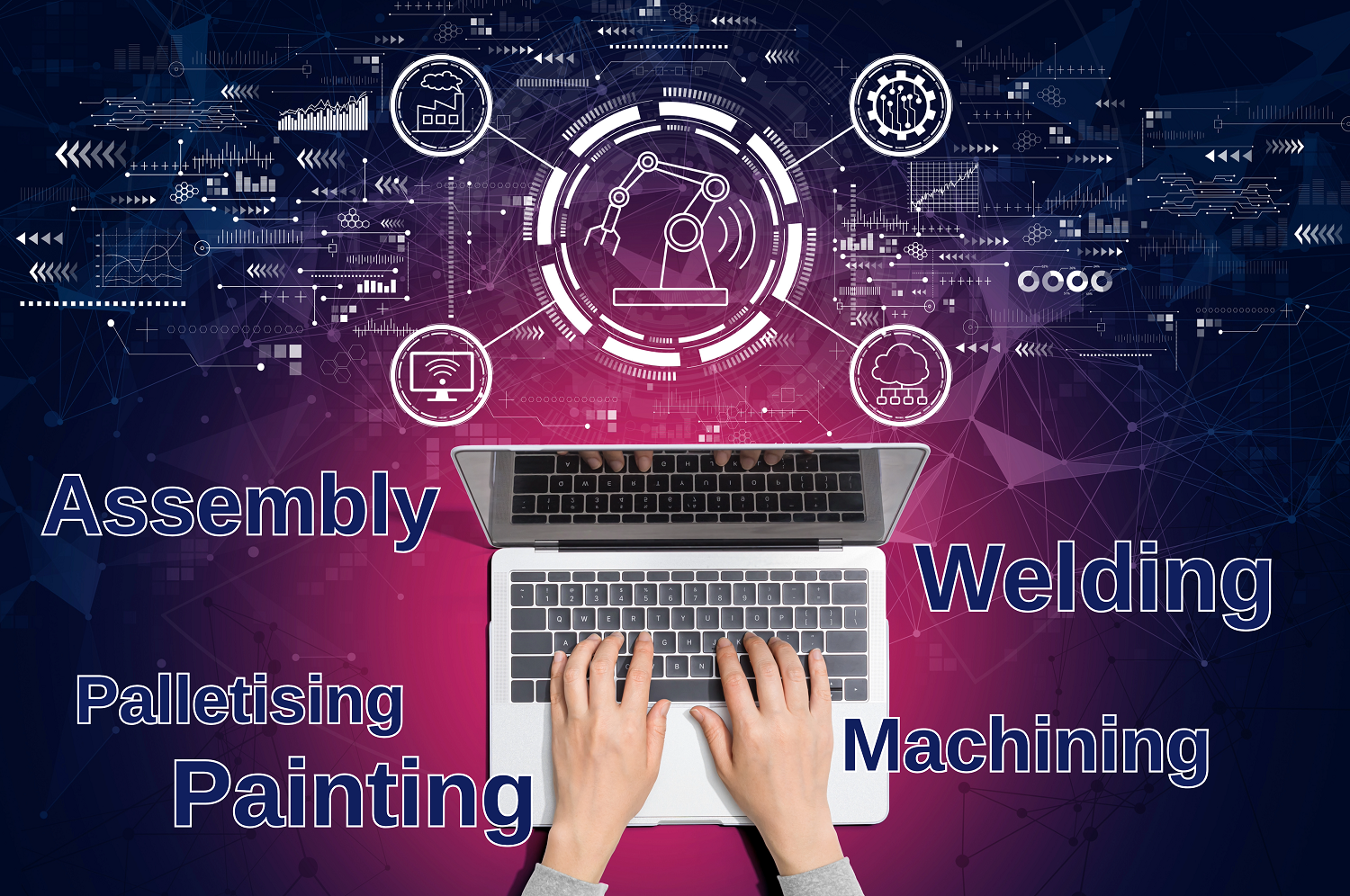
Offline Programming (OLP) for robots allows users to program without physical access to the robot. This is particularly valuable in complex applications where simulation is needed before deployment, manual teaching is too exhausting for human workers, or downtime is costly. Below is a list of high-impact robotic applications most suitable for offline programming.
1. Robotic Welding
Welding is one of the most common robotic applications, and one of the most complex to program manually. Offline programming allows engineers to simulate weld paths, maintain consistent torch angles, and avoid collisions with the part or fixtures. For example, in automotive industries where robots need to weld hundreds of points or long continuous seams, creating these paths directly on the robot can take a long time. OLP enables quick development and adjustment of welding programs, reduces setup time, and makes it easier to simulate weld access and less reliant on experienced welders.
2. Robotic Machining
When robots are used for machining, such as milling or grinding complex surfaces, they need to follow accurate 3D toolpaths. These paths are often generated using CAM (Computer-Aided Manufacturing) software. With OLP, CAM paths can be converted into robot movements that consider joint limits, orientation constraints, and reachability. For example, in aerospace or mould-making, robots might be used to machine large composite parts or moulds. Offline programming ensures these complex contours are followed precisely without trial-and-error on the robot.
3. Robotic Painting and Spraying
Robotic painting demands smooth, continuous paths with tight control over speed, orientation and distance between the spray gun and the surface. OLP allows simulation of the entire spray process, helping optimise paint coverage and minimise overspray. Automotive industries benefit significantly by using OLP to generate complex paint trajectories for car bodies or components. Additionally, offline simulation makes it easier to tweak paths for different product variants or sizes without downtime.
4. Assembly, Packaging and Palletising
In assembly and packaging cells, robots often need to perform repetitive sequences which are optimised for motion, time, space, and collision avoidance. To ensure accuracy and efficiency, OLP can help simulate different scenarios and configurations in much shorter time and create routines that can be adjusted as new products or part geometries are introduced. This is particularly useful when customers have multiple product variants or rapidly changing SKUs.
5. Additive Manufacturing (3D Printing)
Robotic additive manufacturing has become ever more popular and OLP is essential. Robots can be used for large-scale 3D printing of concrete, plastic, or metal, and these paths must be pre-planned using CAD/CAM software. Printing requires coordinated and layer-by-layer robotic motion over curved or irregular surfaces, with synchronised extruder and robot instructions. Offline tools and simulation can help planning and visualisation of the whole process before committing to a build.
6. Applications Involving External Axes
When a robot is mounted on a linear track or works with a rotary positioner, coordinating all axes manually becomes complex. OLP allows synchronised motion between the robot and external axes, simulating different motion groups as a whole system. For example, a robot might move along a track to weld a long tube while the tube is rotated by a turntable. This kind of coordination is best handled in a simulation before deployment.
Conclusion
Offline programming is more than just a convenience. It’s a necessity in modern manufacturing where speed, precision, and adaptability are key. Applications that involve complex paths, tight tolerances, or frequent program changes benefit the most. By simulating and validating robotic operations virtually, companies can innovate faster, reduce costs, and ensure a higher level of reliability on the production floor.